
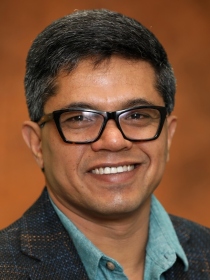
Prakash Kashwan
Connect with Prakash
About Prakash
Kashwan’s research and scholarship speaks to the fields of climate policies, institutions and governance, environmental and climate justice, and global conservation. He is the author of Democracy in the Woods: Environmental Conservation and Social Justice in India, Tanzania, and Mexico (Oxford University Press 2017), co-author of Decolonizing Environmentalism (Bloomsbury 2025), and one of the Editors of the journal Environmental Politics. He also holds faculty affiliations with the Heller School of Social Policy & Management, Politics Department, and the International & Global Studies Program at Brandeis.
Contributions
In the News
Publications
Critiques mainstream environmental movements for perpetuating colonial and capitalist ideologies, despite recent commitments to anti-racism. Advocates for a radical, transformative environmentalism grounded in intersectional ecofeminism, Indigenous sovereignty, and strategies honed in the trenches of transnational environmentalism.
Examines how Maine’s red-green coalition—comprising labor unions, environmentalists, and climate advocates—successfully influenced offshore wind policy through more democratic means than typical government-led stakeholder consultations.
Critiques global restoration prioritization efforts, highlighting that while many studies emphasize the ecological benefits of focusing restoration in the tropics, they often overlook the equity implications. Findings show that top-priority areas for restoration often fall in poorer, more food-insecure regions where agriculture is vital, potentially harming local livelihoods.
Advances scholarship on a comparative politics of environmental justice in diverse contexts. Draws on the tools and concepts from institutional analysis and comparative environmental politics to investigate the structuring effects of institutions while also accounting for the differences of political capabilities of main actors in society, market, and politics.
Critiques the deep-rooted colonial and racist legacies in global conservation, arguing that these persist in dominant philosophies, models, and institutions. Highlights how major conservation NGOs have, in some cases, reinforced exclusionary systems—especially through militarized conservation.
Provides a clear, accessible introduction to climate justice, focusing on distributional, procedural, and recognitional dimensions. Highlights three key blind spots in current debates: ignoring the root causes of climate change, wrongly assuming that all climate action contributes to climate justice, and lacking clear pathways to achieve climate justice.
Examines how social, economic, and political inequalities—such as race, gender, caste, and class—shape access to and control over the commons. Proposes a research agenda to expand commons theory and strengthen ties with critical property and environmental justice studies.
Introduces a special issue that rethinks the role of power in institutional change under neoliberalism. Proposes a new framework to analyze how diverse actors, from elites to grassroots groups, influence institutions.
Presents a unique approach to answering questions about environmental protection and social justice by considering the role of land rights. Examines the role of democracy in negotiating the contradictions between environmental protection and social justice goals
Develops arguments about “political choice” mechanisms that help explain the linkages between inequality and national policymaking related to the establishment of protected areas. Suggests that inequality can weaken the positive impact democracy typically has on conservation efforts.