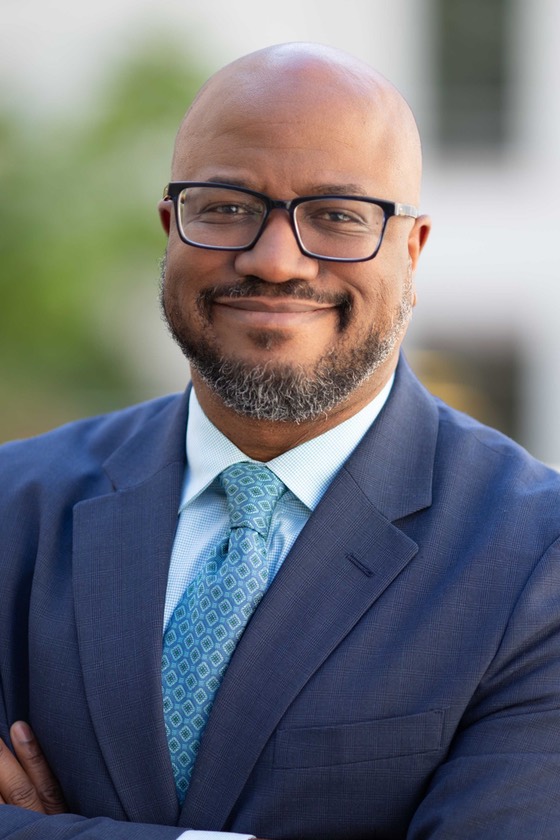
Profile picture for user MichaelLeoOwens

Michael Leo Owens

Professor of Political Science, Emory University

About Michael

Owens' research focuses on local and state politics and policies, policing and imprisonment, racial politics, and religion and politics. Overarching themes in Owens' writings include political representation and empowerment, policy advocacy, social inequality and welfare, and policing and criminal punishments. Owens' books include Deadly Force: Police Shootings in Urban America (Princeton University Press 2025, co-authored with Tom Clark and Adam Glynn) and God and Government in the Ghetto: The Politics of Church-State Collaboration in Black America (University of Chicago Press 2007).

In the News

Research discussed by J. Brian Charles, in "Breaking Up Is Hard to Do: Why Some States and Cities Want to Secede," Governing, June 19, 2018.
Quoted by Ross Terrell in "Gwinnett Could Elect First Nonwhite School Board Members," WABE, May 2, 2018.
Quoted by Suzanne Monyak in "Can an African American Berniecrat Push Southern Democrats Left?," The New Republic, November 7, 2017.
Opinion: "‘Banning the Box’ Would Help People Released from Prison Rebuild Their Lives," Michael Leo Owens, The Conversation, August 3, 2015.
Opinion: "Mass Incarceration Does Injustice to Millions of American Children," Michael Leo Owens, The Guardian, August 19, 2013.
Opinion: "Reduce Economic Immobility," Michael Leo Owens, Atlanta's Economic (Im)mobility, Atlanta Journal-Constitution, August 14, 2013.
Opinion: "MLK Day: A ‘Day On’ for What?," Michael Leo Owens, Opinion: Need to Know on PBS, January 18, 2013.
Opinion: "Let My Preachers Endorse: A Modest Church-State Proposal," Michael Leo Owens, Religion Dispatches, November 18, 2012.
Opinion: "Transportation Tax Could be Tough Sell," Michael Leo Owens, Atlanta Journal-Constitution, August 24, 2010.
Opinion: "Why Blacks Support Vouchers," Michael Leo Owens, New York Times, February 26, 2002.

Publications

Deadly Force: Police Shootings in Urban America (with Tom S. Clark and Adam N. Glynn). (Princeton University Press, 2025).

Draws on original data, compiled by the authors, to examine police shootings, both fatal and non-fatal, in hundreds of American cities. Documents racial disparities in shooting incidents and shows that the media spotlight on the most shocking fatal shootings tell only part of the story of police gunfire in our cities.

"Weakening Strong Black Political Empowerment: Implications from Atlanta’s 2009 Mayoral Election" (with Jacob Brown). Journal of Urban Affairs 36, no. 4 (2014).

Tells the story of how, after decades of struggle, Blacks control the city halls of many cities. Their challenges to retaining them in the 21st century are great.

"The Political Determinants of Women’s Descriptive Representation in Cities" (with Adrienne Smith and Beth Reingold). Political Research Quarterly 65 (2012): 315-329.
Explains how urban political context affects women’s numerical representation in local government, and the political characteristics of local communities are consequential for predicting the presence of women as municipal policymakers.
"Uneven Reparations for Wrongful Convictions: Examining the State Politics of Statutory Compensation Legislation" (with Elizabeth Griffiths). Albany Law Review 75 (2011/2012): 1283-1327.

Discusses the struggle that many of the wrongly-convicted people face in their quest to acquire compensation for unjust imprisonment along with aid for social reintegration.

"The Distributive Politics of ‘Compassion in Action’: Federal Funding, Faith-Based Organizations, and Electoral Advantage" (with Amy Yuen). Political Research Quarterly 65 (2012): 422-442.
Suggests that federal social welfare funding for faith-based organizations during the George W. Bush administration may have served a combination of purposes, including grants for both electoral purposes as well as help for meeting social needs.
"'Deviants' and Democracy: Punitive Policy Designs for Poor Citizens with Drug Felonies" (with Adrienne Smith). American Politics Research 40 (2012): 531-567.
Explores the question: why do some states take a punitive approach toward poor citizens using drugs, while others look for ways to reduce punitive responses to lawbreakers, including felons?
"Faith-Based Initiatives" in Encyclopedia of Religion in America, Volume 2, E-K, edited by Charles H. Lippy and Peter W. Williams, (Congressional Quarterly Press, 2010).
Provides a concise definition and brief history and contextual discussion of faith-based initiatives.
God & Government in the Ghetto: The Politics of Church-State Collaboration in Black America (University of Chicago Press, 2007).
Draws on survey data and fieldwork to show how government grants to faith-based organizations have created a means for black clergy to reaffirm political leadership and enhance their moral authority in black civil society.