Can you explain what the Massachusetts law does and how you got involved?
Carrie: This law requires all public universities to provide medication abortion in their campus health centers or refer patients to telehealth or nearby providers. Massachusetts was the second state in the country to pass this kind of law, after California. The law covers the four UMass campuses plus nine state universities.
Medication abortion is simple—providers prescribe it, the student picks it up in the health center or connected pharmacy, and then takes it back to their room to use. With everything happening after the Supreme Court overturned Roe v. Wade, there was concern that wait times at clinics would get longer and that it was burdensome to ask students to go off campus. There was also a need to integrate this care into mainstream medicine, which it hadn’t been because of stigmatization.
I know my legislator, Rep. Lindsay Sabadosa—we live in the same town and have talked over the years. When she heard California had passed its law, she became interested in drafting legislation for Massachusetts, but felt she needed research on the barriers to medication abortion experienced by students. She asked me to do this research. California researchers had conducted such a study to support its law, so I reached out to those researchers, and they walked me through how they did their research. I modeled my study on theirs.
I published the research in the journal Contraception. Representative Sabadosa asked me to testify so legislators could understand the barriers students face and why on-campus access matters. We also educated them about how safe the medications are and that students who get prescriptions off campus still return to campus to use them—so providing them on campus isn’t fundamentally different.
To raise awareness about the legislation, I wrote a column for the Daily Hampshire Gazette, and spoke to many media outlets about the issue, including The Boston Globe and elsewhere. The advocacy group Reproductive Equity Now (REN) featured my research on their website. They created a map and a webpage that visually represented the research, which was wonderful. We could direct legislators to that or print it out and share it.
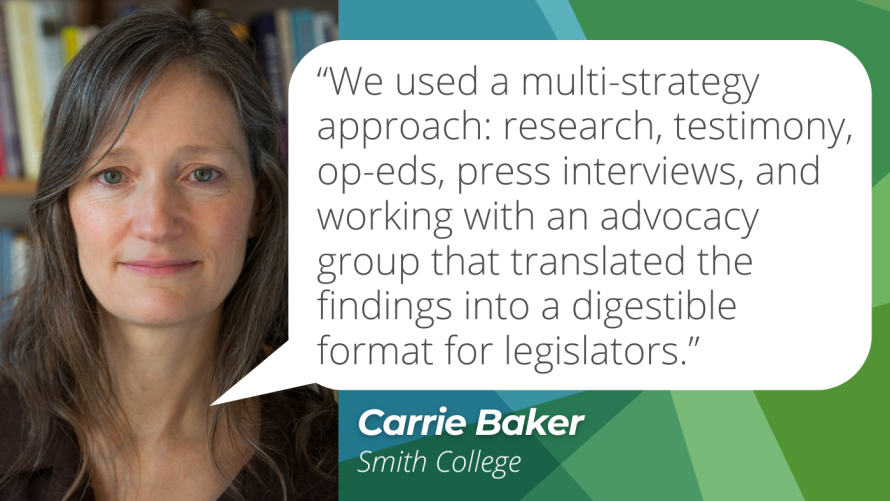
So we used a multi-strategy approach: research, testimony, op-eds, press interviews, and working with an advocacy group that translated the findings into a digestible format for legislators.
What impact have you seen since the law went into effect?
Carrie: It's always a work in progress. I teach a class on gender, law and policy, and I tell my students that getting a law passed is just half the battle—implementation is the other half. Many schools are now providing this care. For example, UMass Amherst’s health clinic now offers it on campus, so students don't need to go off campus. They can get the medication right there on campus.
The organization Advocates for Youth created an implementation committee that worked to publicize the service, and there have been efforts to get campus health centers to put the information about medication abortion on their websites. The Massachusetts law applies to state schools, not private schools, but activists have used the fact that state schools offer medication abortion to put pressure on private schools. For example, students at private colleges have pointed to UMass when they suggest their schools should provide the same care.
A few other states have passed similar laws, including New York and Illinois. I’ve covered these campaigns in my public writing. Illinois was the first Midwestern state to do this, which is important because they’re surrounded by states with bans.
I recently consulted with a New York City legislator who worked on passing their law and he now wants to focus on implementation. Actually, SSN set up that meeting. We talked about making sure students know about the service. Sometimes campuses have the service but don’t want to publicize it because they’re worried about being targeted, but that defeats the purpose. I’ve consulted with advocates in other states over the years and am definitely available to keep doing that.
How did you become a regular contributor to Ms. magazine and your local newspaper?
Carrie: I took a public writing workshop in 2010 offered by Ms. magazine Later, I did a training with The OpEd Project. In these workshops, I learned the fundamentals: how to write for the public, and how to translate scholarly work into public-facing writing.
And then I just practiced. I kept doing it. Because I had taken the Ms. writers workshop, I got a piece published there and developed relationships with the editors. Now I run their Ms. Committee of Scholars, which is a nationwide group of feminist scholars who write for the public. I help lead the Ms. writers workshops and I recruit writers for the magazine. I’m very evangelical about it because it’s incredibly fun and meaningful work.
For the Daily Hampshire Gazette, I started by sending a few guest columns to them, and from that they invited me to become a regular columnist. I have the fourth Thursday of every month. I’ve been doing that for about 3½ years. I really enjoy it. It’s very different from writing for Ms. magazine. Ms. has a national feminist audience, while the Gazette has a much more politically diverse regional readership in Western Massachusetts. I have to tailor my writing for different audiences.
And then there’s my radio show on WHMP in Northampton. I was originally invited on as a guest. They later invited me to do a regular show. So once a month, on the third Tuesday, I host a half-hour show called Feminist Futures. I bring on interesting feminists from around the area to talk about their work—everyone from the director of the local domestic violence shelter, to people working on trans health, to the carpenters’ union pushing for more women in the trades. I’ve been doing my radio show for about three years.
More recently, they asked me if I’d co-host the larger two-hour program that my show is part of—Talk the Talk, which airs live Monday through Friday from 8–10 a.m. and reruns from 4–6 p.m. So now I’m hosting three different segments in addition to my own show. It’s really fun. Radio is totally different from public writing or academic work—it’s live, you have to think quickly, and you’re constantly shifting gears. One minute you’re interviewing a legislator about the state budget; the next you’re talking to a school superintendent or participating in a comedy show. It’s been a great way to stretch myself and learn new skills.
What advice would you give people who want to build these kinds of media connections?
Carrie: In addition to the writing workshops, I did the Women’s Media Center training, which was a weekend-long workshop in Washington, D.C. They taught us how to present ourselves on television, how to do radio, how to handle press interviews—those kinds of things.
I do a lot of interviews with newspapers and magazines. There are very concrete skills involved in doing that well. For example, thinking ahead about your three main points—and repeating them. Academics tend to wander down rabbit holes, and you can’t do that in a press interview. Your main point will get lost, especially if you’re talking to a non-expert audience. You want the bare bones, stated clearly and repeatedly, so that’s what reporters hear and ultimately quote.
As far as developing relationships with the media, it’s definitely easier with local outlets. They're nearby, there's less competition, and they may already know who you are. If I say, “I teach at Smith College,” local reporters will look me up and say, “Okay—what do you have to say?”
National outlets are much harder. I've pitched pieces to tons of places and never heard a word back. That was true years ago, and it’s still true now. Breaking in at the national level is extremely difficult. It can happen, but it’s not easy. Letters to the editor are a bit more accessible than guest essays. I had a letter in The New York Times recently after the Charlie Kirk story, but you have to be short, concise, punchy, and respond to something that’s happening right now.
Really, for all public writing, you have to be right on the pulse of the moment—media moves fast, and everything is about trends, news hooks, and catching the wave. Even then, it’s hard.
If you have connections, that’s always helpful. But even without them, the biggest thing is persistence. I tell my students that the difference between failure and success is persistence. Keep trying. Keep sending pieces out. If you've been published once in a place like The New York Times, they’re more likely to take a second look. You build momentum simply by doing more of it.
I’m also part of an organization that connects journalists to experts: the Women’s Media Center. They have a database called SheSource, which provides sources that journalists can use when they’re covering issues related to women.
And the other place is your own college comms department. I have a very close relationship with our communications office. They pretty regularly refer media to me, or when I write something publicly, I share it with them and they amplify it out to the alums.
I’m always thinking about how I can amplify my work outward—not just writing it, but once it’s written, getting it out to new and more audiences. I’m on all the social media, trying to amplify the work: Facebook, LinkedIn, Instagram, Bluesky, and Threads. I am still on Twitter, but that’s not really a viable platform anymore. Every time I publish something or have a new radio show, I post on all those different platforms.