
Did U.S. Income Inequality Rise or Fall during the Recent Great Recession?

Rising income inequality in the United States has set off alarm bells, as experts and public commentators alike note the disproportionate gains made in recent decades by the top one percent. Some analysts like economist Emmanuel Saez claim that the very richest Americans continued to make disproportionate income gains even during the recent Great Recession. But my reexamination using improved data from the Congressional Budget Office suggests that, in fact, income gaps during the downturn were ameliorated by U.S. government action.
New Attention to Income Inequality
A quick overview reveals that worries about overall income inequality and the fortunes of the very rich are a recent development.
- Prior to 1980, neither scholars nor public policymakers paid much attention to income inequality, because data then available suggested little change over time in income shares going to different slices of the U.S. population. Poverty was the chief concern following the 1962 publication of Michael Harrington’s The Other America.
- After the two recessions between 1979 and 1982, attention shifted to changes in business practices and the economic fortunes of the middle class. Hundreds of papers, monographs, and books were written about U.S. earnings and income inequality, but almost all relied on government surveys that did not have details on the incomes of the wealthiest Americans.
- In a breakthrough in the late 1990s, Thomas Piketty and Emanuel Saez started using records from the Internal Revenue Service to show that the top one percent of U.S. income earners – even the top one-hundredth of one percent – had been capturing a wildly disproportionate share of growing national income.
Trends in Fortunes at the Very Top
The top one percent’s share of all U.S. income – from capital gains as well as wages and salaries – grew from 10 percent in 1960 and also 1980 to 21.5 percent by 2000. After that, the share of the top one percent fell to under 17 percent in 2002 before rising to 23.5 percent in 2007.
At the very onset of the Great Recession, the wealthiest one percent of Americans actually saw their incomes decline sharply by 18 percent in 2009. But then their share rose to 21.4 for the years 2012 and 2013 (these two years have to be combined because changes in tax rates for the very rich led many people to shift income and capital gains to 2012, resulting in apparently lower incomes in 2013). That rise seems to bear out Saez’s claim in his 2013 article “Striking It Richer” that the super-wealthy managed to seize more income during and after the Recession.
But an approach that looks at “shares of growth” can be misleading when used to track very short time spans. Starting and ending dates are crucial and slight changes in them can suggest very different conclusions. True enough, the income share of the U.S. top one percent rose from 2009 to 2012 – but only after that share dropped even more from 2007 to 2009. If Saez had tracked the entire span from 2007 to 2012 (and made valid adjustments for tax policy effects), his results would have revealed that the shrinking income share of the top one percent was responsible for more than a third of the 13% overall national decline in that span.
A New Analysis with Better Data
Starting in 2012, the Congressional Budget Office issued new data tracking income movements for various levels of U.S. earners, including the top one percent. Although Piketty and Saez only count market income and exclude government cash transfers such as Social Security, unemployment insurance, and welfare payments, the Congressional Budget Office tallies all government cash and non-cash “transfer” benefits as well as employer benefits and tax liabilities and refunds, providing a much fuller picture of income trends, as the following table shows (using the data through 2011, the most recent year for which they are available).
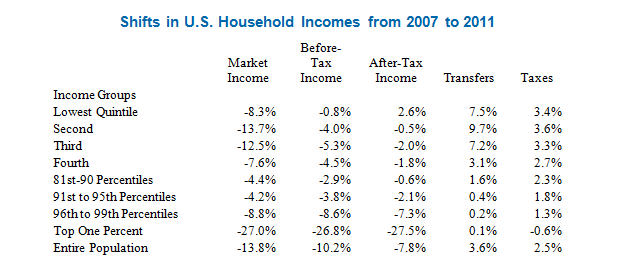
More complete data from the Congressional Budget Office highlight the effectiveness of public policies at ameliorating income losses for most U.S. households during the Great Recession. Extra help arrived through a combination of automatically expanded benefits like Food Stamps and unemployment payments, through temporary reductions in Social Security taxes, and because of extra government efforts to stimulate the nation’s economy and limit job losses. Meanwhile, the wealthiest temporarily lost ground, especially because of declines of investment income. From 2007 to 2011, income inequality in the United States actually declined a bit.
But we should not conclude that long-term trends have been reversed. Like Piketty and Saez, the Congressional Budget Office shows that U.S. income gaps are now much higher than they were in 1980. America’s very rich took a temporary hit during the Great Recession, but they have still managed to gain a huge share of U.S. income, much more than they claimed before 1980.